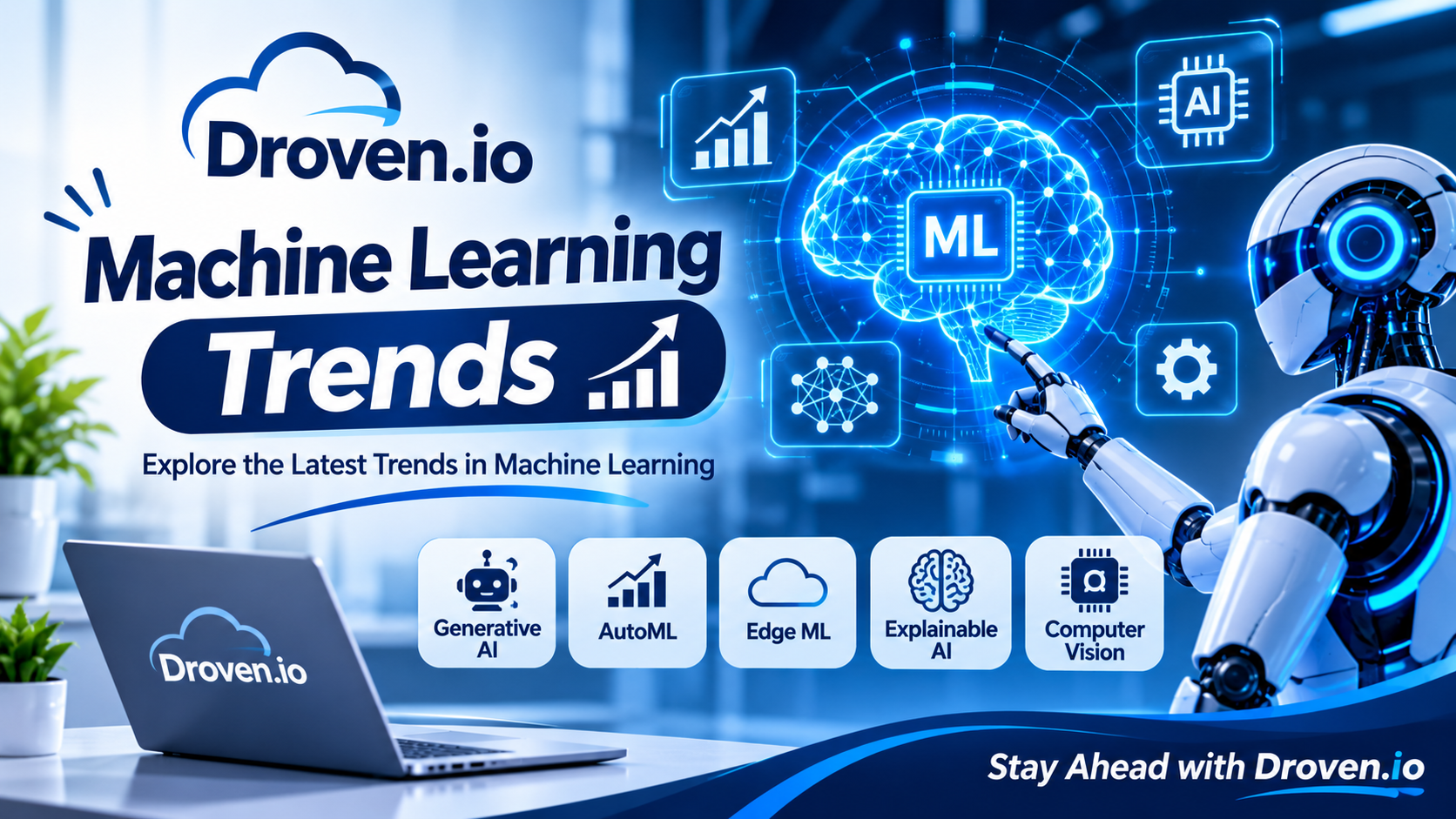
Machine learning is becoming an important part of modern technology. From personalised recommendations and online shopping to healthcare, financial services, and automation, this technology is changing how people interact with digital systems. Businesses are also using machine learning to analyse information, improve operations, and make more informed decisions.The Droven.io Machine Learning Trends topic explores the latest developments in this field and explains how intelligent systems are evolving.
As technology advances, machine learning is moving beyond traditional data analysis towards more advanced applications involving artificial intelligence, automation, and real-time decision-making.Understanding these developments can help students, developers, business owners, and technology enthusiasts prepare for future opportunities.
What Is Machine Learning?
Machine learning is a branch of artificial intelligence (AI) that enables computers to learn patterns from data and improve their performance without requiring programmers to write instructions for every individual task.
Instead of following only fixed rules, machine learning models analyse information, identify relationships, and use those patterns to make predictions or decisions.For example, an online shopping platform can study customer browsing behaviour and purchase history to recommend products that may interest them. Similarly, email services use machine learning to identify spam messages and separate them from important communication.
Major Machine Learning Trends in 2026
Machine learning continues to develop as researchers and technology companies introduce more advanced models and practical applications. Several important trends are influencing how organisations build and use intelligent systems.
Generative AI and Machine Learning
Generative AI is one of the most noticeable developments in modern machine learning. These systems can create different types of content, including written text, images, audio, and computer code.Unlike traditional machine learning applications that mainly classify information or make predictions, generative models can produce new outputs based on patterns learned from training data.
For example, businesses can use generative AI to prepare content drafts, developers can generate code suggestions, and designers can explore creative concepts through AI-powered applications.The combination of machine learning and generative AI is creating new opportunities for productivity, creativity, and digital innovation.
Automated Machine Learning (AutoML)
Automated Machine Learning, commonly known as AutoML, is making machine learning development more accessible. Traditional model development often requires programming knowledge, statistical understanding, and experience with data preparation.AutoML tools simplify several of these processes by automating tasks such as model selection, feature engineering, and parameter optimisation.
This approach can help beginners and smaller organisations experiment with machine learning without building every component manually. However, human supervision remains important because automated systems still require suitable data, testing, and evaluation.
Explainable Artificial Intelligence (XAI)
As machine learning becomes more common in important decision-making processes, understanding how models reach their conclusions is increasingly important.Explainable AI focuses on making machine learning predictions and decisions easier for people to understand.
For example, a financial institution using an AI model to evaluate loan applications may need to understand which factors influenced a particular decision.Explainability can help developers identify errors, improve transparency, and build confidence in intelligent systems. It is especially relevant in areas such as healthcare, finance, education, and public services.
Edge Machine Learning
Edge machine learning involves running machine learning models directly on devices or near the location where data is generated rather than sending every piece of information to a remote cloud server.Smartphones, security cameras, connected vehicles, and industrial sensors can use this approach to process information locally.
One important advantage is reduced communication delay. For example, a smart security camera can identify movement locally and respond without sending every video frame to a distant server.Edge machine learning can also reduce network usage and support applications that need faster responses. However, device processing power and battery limitations must be considered.
Machine Learning in Healthcare
Healthcare is another industry experiencing important developments through machine learning. Intelligent systems can analyse medical images, identify patterns in patient information, and support certain clinical research activities.For example, machine learning models can assist specialists in examining medical scans and identifying unusual patterns that may require further investigation.
Researchers also use these techniques to study large datasets and explore potential relationships between different health factors.Although these applications offer valuable possibilities, machine learning systems should support qualified medical professionals rather than replace clinical judgement. Accuracy, privacy, and proper testing remain essential.
Small and Efficient Machine Learning Models
Another important direction is the development of smaller and more efficient machine learning models.Large models can require significant computing resources, memory, and electricity. Smaller models are designed to perform specific tasks while using fewer resources.These models can be particularly useful for smartphones, laptops, embedded systems, and organisations with limited computing budgets.
In addition, smaller models can support faster responses and local processing. This trend is encouraging developers to focus not only on model size but also on efficiency, accuracy, and practical performance.
Agentic AI and Autonomous Systems
Agentic AI is an emerging development in which AI-powered systems can work towards specific goals by planning steps, using tools, and carrying out tasks with varying levels of independence.For example, an AI agent might collect information, organise research findings, prepare a report, and ask a human for approval before completing an important action.
Machine learning contributes to these systems by helping them interpret information, recognise patterns, and improve task performance.Businesses are exploring agentic systems for customer support, workflow management, software development, and administrative activities. Human supervision, clear permissions, and reliable evaluation remain important when these systems perform complex tasks.
Responsible and Ethical Machine Learning
As intelligent systems become more widely used, responsible machine learning is receiving greater attention.Models can produce unfair or inaccurate results when training datasets contain errors, incomplete information, or historical biases. These problems may affect decisions in employment, education, financial services, and other important areas.
Responsible machine learning focuses on improving fairness, protecting personal information, monitoring model performance, and making systems more transparent.Developers and organisations need to evaluate their models regularly and ensure that automated decisions receive appropriate human oversight.
How Machine Learning Is Transforming Different Industries
Machine learning is no longer limited to research laboratories or technology companies. Its applications are expanding across several industries.
- Healthcare: Machine learning supports medical image analysis, research, and the identification of patterns in healthcare information.
- Finance: Financial institutions use intelligent models for fraud detection, transaction monitoring, risk assessment, and customer service.
- Education: Educational platforms use machine learning to recommend learning materials, analyse student performance, and support personalised learning experiences.
- Retail and E-commerce: Online businesses use recommendation systems, customer behaviour analysis, and demand forecasting to improve shopping experiences.
- Transportation: Machine learning supports traffic prediction, route optimisation, vehicle monitoring, and research into autonomous transportation.
- Manufacturing: Industrial organisations use predictive maintenance and automated inspection systems to identify potential equipment problems and improve production processes.
These applications demonstrate how machine learning can support efficiency, analysis, and decision-making in different working environments.
Benefits of Modern Machine Learning Trends
Modern machine learning developments provide several advantages for individuals and organisations. One major benefit is improved efficiency, as intelligent systems can automate repetitive activities and process large amounts of information more quickly. Machine learning also supports better decision-making by identifying patterns that may be difficult to recognise through manual analysis.
Another advantage is personalisation, allowing digital platforms to recommend products, services, and learning materials based on user behaviour. Furthermore, developments in automated machine learning and smaller models are making this technology more accessible to businesses with limited technical resources. When properly developed and monitored, machine learning can also improve prediction accuracy, support innovation, and help organisations respond to changing requirements.
Challenges of Machine Learning
Despite its growing potential, machine learning still faces several challenges. One common issue is data quality, because inaccurate, incomplete, or biased information can affect model performance. Another concern is privacy and security, particularly when systems process personal or confidential information. Developing and maintaining advanced models can also involve significant computing costs, technical expertise, and infrastructure requirements.
Additionally, some machine learning systems are difficult to interpret, making it challenging to understand how they reach particular conclusions. Models may also experience performance changes when real-world data differs from their original training information.Organisations can address these problems through proper data management, regular model testing, security measures, and human supervision.
Skills Needed to Explore Machine Learning
People interested in machine learning can start developing relevant skills through education, practical exercises, and personal projects.
Some useful areas to explore include:
- Python Programming: Learn basic programming concepts and understand how to work with data.
- Mathematics and Statistics: Develop knowledge of probability, algebra, and statistical methods.
- Data Analysis: Learn how to collect, clean, organise, and understand datasets.
- Machine Learning Algorithms: Explore classification, regression, clustering, and other learning techniques.
- Deep Learning: Understand neural networks and their applications.
- Model Evaluation: Learn how to test models and measure their performance.
Beginners can start with small projects, such as predicting house prices, classifying emails, or analysing customer behaviour. Practical experience helps connect theoretical knowledge with real-world applications.
The Future of Machine Learning
The future of machine learning is closely connected with improvements in computing infrastructure, data processing, artificial intelligence, and automation.Generative models are expected to become more specialised, while smaller models may support more applications on personal devices. Agentic AI is also developing towards systems that can manage more complex workflows under appropriate supervision.
Another important area is multimodal machine learning, which allows systems to work with different information formats, such as text, images, audio, and video. These capabilities can support more flexible applications across education, communication, research, and business.At the same time, responsible development will remain essential. Organisations will need to balance innovation with privacy, fairness, security, and reliability.
Final Thoughts
Machine learning is continuously changing how modern technology works. From generative AI and automated model development to edge computing and intelligent automation, new developments are creating opportunities across different industries.
The Droven.io Machine Learning Trends topic provides an educational starting point for understanding these developments and their practical importance. Whether you are a student exploring artificial intelligence, a developer building intelligent applications, or a business owner interested in digital innovation, following machine learning trends can help you understand the direction of modern technology.