Introduction
A car accident can happen unexpectedly, even to the most careful driver. A brief moment of distraction, an unexpected traffic situation, or another driver’s mistake can result in anything from a small bumper scratch to extensive structural damage. Regardless of the severity, dealing with the consequences requires careful decisions.
After an accident, most vehicle owners have several questions. Is the car safe to drive? Which components need to be repaired? Should an insurance claim be submitted? Is a professional damage assessment necessary? Finding reliable answers to these questions is essential before repair work begins.
Professional accident restoration involves much more than improving the vehicle’s appearance. It includes examining the body structure, identifying hidden damage, repairing affected components, restoring the paintwork, and checking important safety systems.
Choosing an experienced bodywork and paint repair workshop can make this process easier and help ensure that the vehicle is restored to an appropriate technical and visual condition.
The First Steps After a Road Accident
The moments immediately following an accident can be stressful. However, taking the correct steps helps protect everyone involved and makes the subsequent repair process more organized.
The first priority should always be personal safety. Drivers should check whether anyone has been injured and contact emergency services when necessary. If the vehicles are creating a dangerous situation, appropriate safety measures should be taken without putting anyone at further risk.
Once the situation is safe, the accident should be documented.
Useful information includes:
Photographs of the damaged vehicles.
The location and circumstances of the accident.
Registration details of the vehicles involved.
Contact information of the other driver.
Insurance information.
Details of any witnesses.
Relevant police documentation, where applicable.
These records can be useful when reporting the incident to an insurance company and arranging a professional damage assessment.
Drivers should avoid assuming that a vehicle is safe simply because it can still move. Damage to steering, suspension, cooling systems, lighting, or structural components may not be immediately visible.
If there are signs of significant damage, the vehicle should not be driven until its roadworthiness has been properly assessed.
Why a Professional Damage Assessment Is Important
One of the biggest mistakes after an accident is judging the extent of damage only by looking at the exterior.
A bumper may appear to have suffered a relatively minor impact, but the collision could also have affected components behind it. Similarly, damage to a door or side panel may involve structural sections that require more detailed examination.
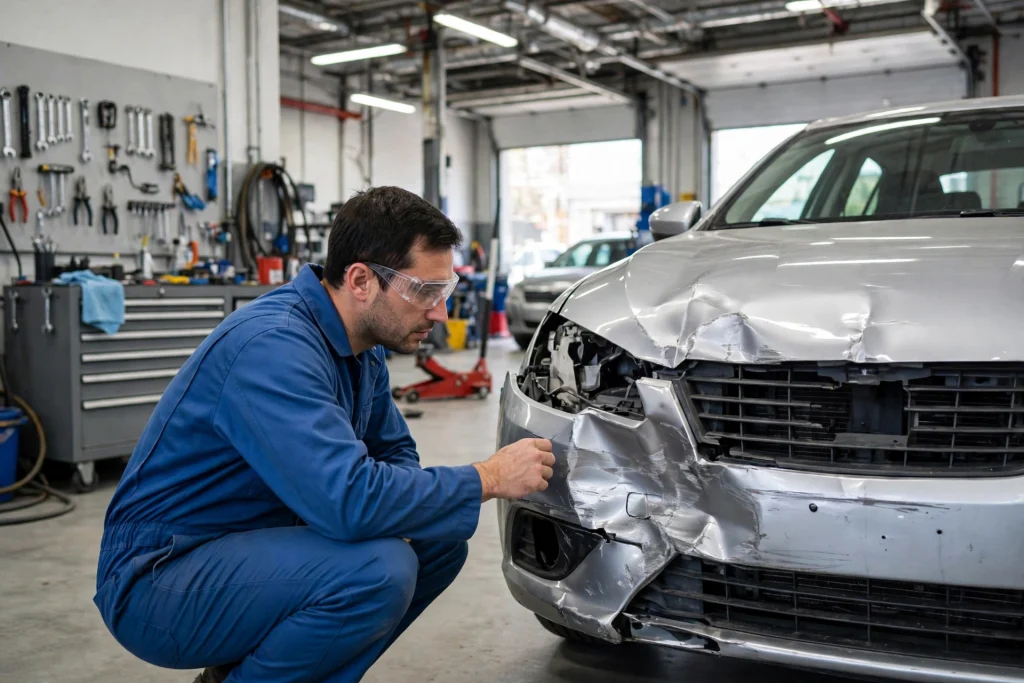
A professional workshop can inspect the vehicle and identify visible as well as potential hidden damage.
This process may involve examining the body panels, supporting structures, mounting points, and other affected components.
For more substantial structural damage, specialized measuring equipment and a professional straightening bench can help technicians assess whether the vehicle’s body geometry has changed.
The objective is to establish exactly what needs to be repaired before beginning the work.
LR Lackdesign offers an initial damage assessment and cost estimate for accident-related repairs in Grevenbroich. The workshop also documents the damage photographically and can arrange an independent vehicle assessment through its specialist partner when required.
Different Types of Accident Damage Require Different Solutions
Every accident is different. The appropriate repair method depends on the impact location, the severity of the damage, and the components involved.
Front-End Collision Damage
Front-end accidents frequently affect the bumper, bonnet, grille, headlights, and front wings.
In more serious collisions, the radiator support and other structural components may also be affected.
Even when the visible damage appears limited to the bumper, technicians should check the components behind it.
A professional repair may involve replacing damaged parts, straightening affected metal sections, restoring mounting points, and refinishing the repaired surfaces.
The headlights and associated electronic systems should also be checked where necessary.
Rear-End Collision Damage
Rear-end collisions can damage the bumper, boot lid, rear lights, and surrounding body panels.
In some situations, the impact may also affect the rear structural sections.
A detailed inspection helps identify whether the damage is limited to exterior components or extends to the supporting structure.
Once the necessary repairs are completed, the affected surfaces can be prepared and painted to match the surrounding finish.
Side-Impact Damage
Side collisions can affect doors, side skirts, wheel arches, pillars, and other body sections.
The severity of the damage depends on the direction and force of the impact.
A dented door may require panel repair or replacement, while more substantial damage could involve structural components.
Because side-impact damage can affect occupant protection systems, technicians must also consider the condition of relevant safety equipment and electronic systems.
Parking Accidents
Not every accident happens at high speed.
Minor parking incidents can leave scratches, dents, and damaged bumpers. Although these problems are often cosmetic, they can still affect the vehicle’s appearance and value.
Some small defects can be repaired through Smart Repair, while deeper damage may require localized painting or conventional bodywork.
Glass Damage
An accident can also affect vehicle windows and windscreens.
Depending on the location and severity of the damage, professional stone-chip repair or complete glass replacement may be necessary.
Vehicles equipped with cameras and driver assistance technology may also require recalibration after windscreen replacement.
The Importance of Correct Body Geometry
Modern vehicles are designed with carefully engineered body structures. These structures help provide stability, manage impact forces, and protect occupants during collisions.
When a significant accident occurs, certain sections of the body may become deformed.
Simply pulling a damaged panel into a visually acceptable position is not necessarily enough. Technicians must establish whether the relevant measurements and structural alignment are correct.
Professional workshops use specialized straightening benches and measuring systems to assess and restore body geometry where appropriate.
This is particularly important when the accident has affected structural components or the vehicle’s supporting framework.
Once the structural work is complete, technicians can continue with the remaining bodywork and painting procedures.
Restoring Paintwork After Accident Repairs
Paint restoration is an essential part of professional accident repair.
After damaged panels have been repaired or replaced, the affected surfaces must be prepared for refinishing. This can involve sanding, filling, priming, and applying the appropriate paint layers.
One of the biggest challenges is matching the repaired area with the vehicle’s original color.
Even vehicles with the same factory paint code can show slight differences because of age, sunlight exposure, and previous maintenance.
For this reason, accurate color measurement is important.
LR Lackdesign uses spectrophotometer technology to measure the existing vehicle color and select an appropriate paint formulation. Larger painting jobs are carried out in a heated paint booth to support a controlled finishing process.
The workshop provides a seven-year warranty on its paintwork.
Depending on the damage, a complete panel repaint may not always be necessary. Localized refinishing and partial painting can sometimes restore the appearance while preserving unaffected sections.
Why Modern Driver Assistance Systems Need Attention
Today’s vehicles contain numerous electronic systems designed to assist drivers and improve road safety.
Depending on the model, these systems may include parking sensors, cameras, radar sensors, lane assistance, and automatic emergency braking technology.
An accident can affect these components directly or indirectly.
For example, a damaged bumper may disturb the position of a parking sensor. A collision affecting the front structure could also require checks of associated driver assistance equipment.
After certain repairs or component replacements, calibration may be necessary.
This process ensures that relevant systems operate according to the manufacturer’s specifications.
LR Lackdesign includes the calibration of modern driver assistance systems as part of its accident restoration approach when required.
This is one reason professional accident repairs should not focus exclusively on visible bodywork.
Managing the Insurance Process After an Accident
Insurance procedures can be another source of stress for vehicle owners.
Drivers may need to submit accident information, provide photographs, arrange an assessment, and communicate with insurance representatives.
When several repair components are involved, understanding the estimated costs and the insurance requirements becomes particularly important.
The process generally begins with reporting the accident to the relevant insurance provider.
A damage assessment or repair estimate is then prepared to establish the expected work.
For larger or more complicated accidents, an independent automotive expert may be appropriate.
The specific requirements depend on the circumstances, the applicable insurance policy, and whether the accident was the driver’s fault.
In Germany, drivers involved in an accident that was not their fault generally have the right to choose their repair workshop. However, comprehensive insurance claims may involve contractual restrictions, such as an agreed repair-shop arrangement.
Understanding these differences before authorizing repairs can prevent unnecessary complications.
How LR Lackdesign Handles Accident Restoration
For motorists in Grevenbroich and nearby areas, LrLackdesign provides bodywork, automotive painting, and accident restoration services.
The owner-operated business, led by Leonardo Rios Dieker, focuses on providing customers with a coordinated repair process rather than requiring them to organize every individual service themselves.
Its accident restoration services cover several stages.
1. Initial contact and assessment
Customers can describe the accident by telephone or submit an online inquiry. If the vehicle cannot be driven safely, towing assistance can be arranged.
2. Vehicle inspection
The workshop examines the visible damage and documents the affected areas. An initial cost estimate is provided free of charge.
3. Insurance coordination
The team can assist with damage reporting, communication with the insurance company, and the coordination of necessary documents.
4. Bodywork and refinishing
Damaged body panels are repaired or replaced as appropriate. Structural measurements, paint matching, and relevant electronic calibration are included when required.
5. Final inspection and handover
After the repair work, the vehicle undergoes a quality check and is returned cleaned and ready for collection.
The workshop works with original replacement parts or manufacturer-approved alternatives, depending on the repair requirements.
Customers can also arrange a rental vehicle and benefit from a collection and delivery service.
For drivers who need to have accident damage professionally repaired, LR Lackdesign offers a coordinated service covering damage assessment, bodywork, paint restoration, and insurance-related support.
How Long Does Accident Repair Take?
Repair duration depends on the severity of the damage and the availability of necessary components.
Minor cosmetic repairs may be completed relatively quickly, while more extensive structural work can require significantly more time.
According to LR Lackdesign, smaller accident repairs generally take around two to four working days. Larger bodywork projects may take approximately one to three weeks.
These are indicative timeframes rather than guaranteed completion dates.
The actual schedule depends on the vehicle, repair requirements, replacement parts, insurance approval, and any additional damage discovered during dismantling.
A clear estimate before work begins helps customers plan alternative transportation and understand when their vehicle may be ready.
Choosing the Right Accident Repair Workshop
Selecting a suitable workshop is an important decision because accident restoration affects both appearance and safety.
Before approving repairs, vehicle owners should consider several factors.
First, the workshop should have experience with structural bodywork and automotive painting.
Second, it should have appropriate equipment for measuring body geometry and handling modern vehicle technology.
Third, customers should receive transparent information about repair procedures and estimated costs.
It is also useful to ask whether the workshop can coordinate insurance communication, arrange a rental vehicle, and provide transportation assistance.
Finally, information about replacement parts, paint quality, and workmanship guarantees can help customers make a more informed decision.
Final Thoughts
Recovering from a car accident involves more than repairing visible scratches and dents. A proper restoration process should consider the vehicle’s structural condition, body panels, paintwork, and relevant electronic safety systems.
The best starting point is a professional damage assessment that identifies what needs attention and establishes an appropriate repair plan.
From minor parking incidents to substantial front, rear, and side collisions, different types of damage require different techniques. Correct body measurements, suitable replacement parts, precise color matching, and proper calibration all contribute to a professional result.
Insurance coordination is another important consideration, particularly when the accident involves another driver.
For motorists in Grevenbroich and surrounding areas, LR Lackdesign provides a coordinated approach to accident repairs, including initial assessments, bodywork, painting, and insurance support.
Taking the time to choose an experienced workshop can help restore the vehicle’s appearance, address safety-related concerns, and make the entire post-accident process easier to manage.